
A house on Garfield Drive: discovering Indianapolis history through one ordinary home

I’m passionate about researching and preserving old homes that belonged to regular people.
These are the houses we pass by on our daily drives, the places where ordinary lives unfolded minute by minute, year by year. Often, the most relatable and interesting histories come from these familiar dwellings. The home of a recent client—featured in the blog below—is a perfect example.
Tucked near the bottom of page 11 in the April 4, 1929, issue of The Indianapolis Times, a brief two-line notice informed readers that H. Hilgemeier had filed a building permit for a house and garage on Garfield Drive.

What was likely a quickly forgotten news item for Times readers in 1929—a mere sixty-three characters—has faded even further from memory nearly a century later. Yet by linking this address on Garfield Drive to the Hilgemeier family, the notice transforms the still-standing house into a vessel of Indianapolis history.

The home blends easily into the vast collection of Indianapolis’s early 20th-century housing stock. At first glance, aside from its peculiar curved exterior walls, nothing seems to stand out. A deeper look at how it came into being, however, quickly reveals stories about Indianapolis’s German-American population, the development of its first public park, and the city’s once-thriving meatpacking trade. To see how all of these threads connect back to the Garfield Drive house, we first have to step back several decades and follow the Hilgemeier family’s earlier history on the south side.
The Hilgemeier family and the origins of Garfield Park
The H. Hilgemeier listed in the Times was Harry Hilgemeier, born on October 18, 1879, in Indianapolis. He was the youngest of seven children born to Ferdinand Christian Hilgemeier and Anna Maria Sudbrock, German immigrants who arrived in the United States before the Civil War. Anna and Ferdinand (who went by Maria and Christian) married in Indianapolis in 1860 and were part of the city’s vibrant German community.
German immigration to Indianapolis surged in the mid-19th century, particularly after the failed 1848 revolutions in the German states. Drawn by political freedom, economic opportunity, and religious tolerance, Germans quickly became an influential presence in the city, making up roughly 10–13% of the population by 1850. They were a culturally diverse group, organizing around both churches—Lutheran, Catholic, and German Reformed—and secular clubs such as singing societies and Turnvereins to preserve their language and customs. Maria and Christian would have found Indianapolis an ideal place to raise children as Americans while keeping them closely connected to their heritage.
Harry’s older siblings included two sisters, Mary and Matilda, and four brothers: George, William, Christian, and Frank. In the 1870s, before Harry’s birth, the Hilgemeier family lived on the city’s immediate south side, in a neighborhood now largely occupied by the Lilly Corporate Center. The area was anchored by German-American businesses and institutions such as the C. F. Schmidt Brewery and St. Paul's Evangelical Lutheran Church. For a time, the family resided directly across the street from the Schmidt Brewery, on a section of Wyoming Street that no longer exists.

While the Hilgemeier family lived in the shadow of the Schmidt Brewery, the city of Indianapolis purchased a short-lived horse racing track in January 1874, located in the middle of farmland south of the city, to develop a public park. In its earliest years, the park was known as Southern Park or South Park. It was renamed Garfield Park in 1881 in honor of President James Garfield, following his assassination.
In 1888, when Harry was nine years old, the Hilgemeier family moved to the southernmost edge of the city limits, on the northern border of Garfield Park. They purchased a lot in Beaty's Addition, an early south-side subdivision platted in 1874, just a month after the city acquired the old horse racing track. The addition was developed from the 160-acre Beaty family farm by Elijah Bishop Martindale, one of Indianapolis’s most active real estate men. Responsible for more than 20 additions to the city, Martindale was an astute businessman who quickly recognized the potential of the farmland adjacent to the new city park. His new addition, bisected by Pleasant Run, was massive, with more than 1,000 lots listed for sale.

The 1888 Indianapolis city directory listed the Hilgemeier family as living in the second house north of Raymond Street, on the west side of Gatling Street (known today as Barth Avenue). Land transfers executed by the family from 1889 to 1900 identify the property specifically as Lot 34, Block 7 of Beaty's Addition. Today, the address is 2154 Barth Avenue, and the modest Queen Anne cottage standing there is likely the Hilgemeiers’ original house.

Garfield Park was severely underutilized in the 1880s and had seen little improvement since its establishment in 1874. When the Hilgemeiers moved to the northern edge of the park, parts of it were being used as a cattle pasture, the city having rented the land to farmers over the years. An anonymous letter to the editor of The Indianapolis Journal in 1887 painted a concerning picture:
"Why is this ground rented out, or rather given to some money-making sharper to use for a dairy? We counted fifty head of cows and calves, beside an indefinite number of sheep, swine, horses and mules on the ground, some time since. They skin the roots of the beautiful forest trees and promote their decay, and make this once beautiful ground a disgusting scene of waning enterprise and blasted prosperity, which is a disgrace to the city.
On the day of the gardeners’ picnic, thirty head of cows broke over the old rotten fence and pastured on a German widow’s garden truck. The place is so dilapidated that no one is found there any more, except that class of people that want to shun society and evade the town."
The same year the Hilgemeiers moved near the park, a group of south-side residents lobbied the city to allocate funds for improvements. In 1888, the City Council authorized an ordinance to improve the park, setting aside $10,000 to fund the effort. Additional appropriations of $7,000 followed in 1892 and 1893.
The meat-packing industry and Hilgemeier's subdivision
At the same time improvements were being made to Garfield Park, the Hilgemeiers were busy shaping the surrounding neighborhood. In addition to the lot where their house was located on Gatling Street (now Barth Avenue), the family acquired 15 lots on the north side of Raymond Street, near Pleasant Run. The portion of these lots east of Applegate Street (today East Pleasant Run Parkway South Drive) was developed into the Hilgemeier Subdivision in 1901, which today comprises 802–828 East Raymond Street, a small collection of houses facing south toward Garfield Park.
This subdivision, along with the collection of lots west of Applegate Street, was likely connected to the family’s growing presence in Indianapolis’s meat-packing industry. The city developed into a significant meat-packing hub in the late 19th and early 20th centuries, thanks to its central location and strong rail connections. The Union Stockyards, established in 1877 on the southwest side, became the focal point for livestock trade, drawing cattle, hogs, and sheep from across the Midwest. National firms such as Kingan & Company, a major pork packer originally from Ireland, expanded operations in Indianapolis, employing thousands and making the city one of the leading pork-packing centers in the country.

Christian, the family patriarch, was working in the city’s meat market as early as 1873 and remained active in the industry through the late 1880s and early 1890s. His four sons—Frank, Christian, George, and Harry—had all entered the trade by 1895 (William Hilgemeier died in 1876 at the age of four while the family was living near the Schmidt Brewery; he was tragically crushed by a roller used for grinding corn). Christian Sr. died of heart failure in 1893 at the age of 62, but the family’s business ventures continued. Two years later, in 1895, the firm name Hilgemeier Bros. first appeared in the city directory. By 1899, it was specifically identified as a pork-packing business under the name Frank F. Hilgemeier & Bro.
The exact location of the Hilgemeier family’s early meat-packing operation does not appear on surviving maps from the period, but compelling clues suggest a likely site. In 1894, Christian Jr. was operating as a wholesale meat dealer at the northeast corner of Gray and Raymond Streets—a location corresponding to the fifteen lots the family had purchased in 1887 and later redeveloped, in part, into the Hilgemeier Subdivision. Just two years later, in 1896, The Indianapolis News reported growing neighborhood concerns:
"Property owners near Garfield Park are complaining of the fertilizing establishment of Rauh & Co. and the slaughterhouse of Higemier [sic] Bros. The water from these establishments is drained into Pleasant Run, and flows into the lake in Garfield Park."
Between 1896 and 1900, city directories recorded the Hilgemeier business at the northeast corner of Raymond and Applegate Streets, placing the operation squarely within the footprint of the Hilgemeier Subdivision. George Hilgemeier’s 1948 obituary, which recalled the firm’s founding by his father, Christian Sr., stated that it was located “...in a small plant near Garfield Park.” Taken together, these pieces of evidence suggest that the early Hilgemeier meat-packing enterprise was situated near the banks of Pleasant Run, adjacent to the family’s subdivision.

The Hilgemeier firm placed a full-page ad in the New Year’s Eve 1924 issue of The Indianapolis Star, stating that the business was founded in 1885—right around the time the family was relocating to the Garfield Park area. The ad included “then and now” photographs that reveal what its early operations looked like:

Improvements come to Garfield Park
If Garfield Park left much to be desired in the 1880s when the Hilgemeier family moved to the area, by the 1890s it had been transformed into a tranquil escape, thanks to city funding. In the summer of 1896, The Indianapolis Journal ran an article titled "A Park Gaining Beauty," revealing a park very different from the one that had existed just ten years earlier:
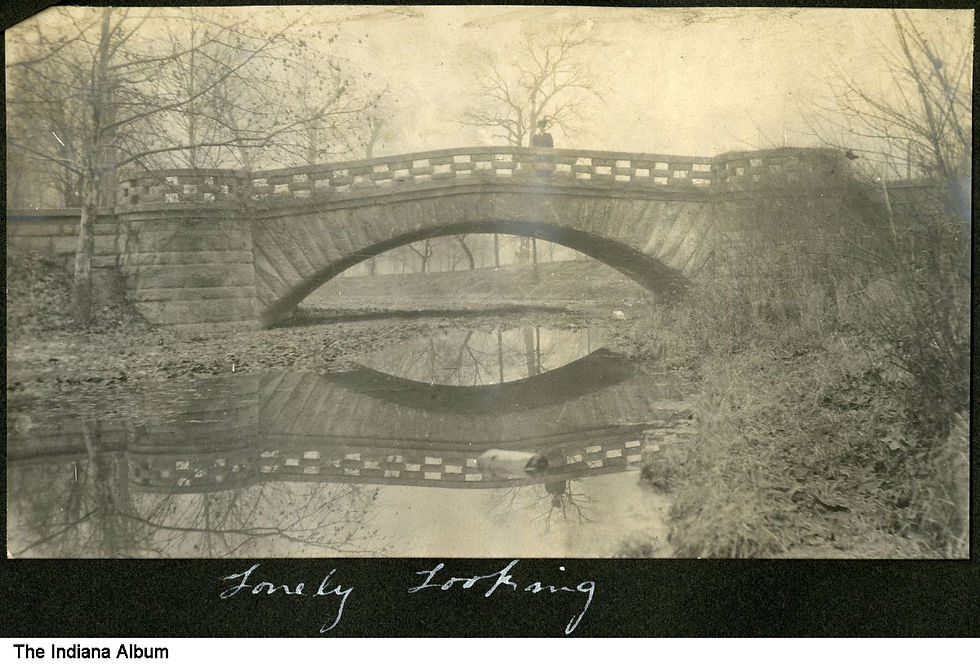
“Now the park is the resort for all classes of people of the city who wish to get a breath of fresh air and enjoy a day away from the cares of the home…. Through the park, from east to west, run two streams, Pleasant Run and Bean Creek…. [A dam] has caused the water to spread over about five acres of land and to back up in the two creeks, forming a beautiful sheet of water, which may soon be available for boating and bathing purposes.
The Board of Park Commissioners is now engaged in the erection of a bridge over Bean Creek, just above the lake. It is a stone arch, of Indiana limestone and oolitic, a structure which will cost the city something over $6,000."
Beyond big-ticket projects like the limestone bridge and dam, the city also invested in the details that made a day in the park enjoyable—paths to wander, shady spots to sit, and flowers to admire:
Paths and driveways have been made through the park extending from the east and west entrances around the bendings of the creeks and among the hills. Benches have been placed at frequent intervals under the shade of the forest trees. Everywhere are seen flower beds and fancy shrubs and decorative trees.
The southern portion of the park is covered with the natural forest trees…. It was of such trees as grow here that Henry Ward Beecher must have spoken when he said: ‘Wealth can build houses and smooth the soil; it can fill up marshes and create lakes or artificial rivers; but no wealth can buy or build elm trees—the floral glory of New England. Time is the only architect of such structures.’ … There are many rustic benches, but best of all is the comforting shade of the huge oaks, ash, hickories, and beeches.”

The promise of Garfield Park was recognized in 1895 by a member of the Indianapolis Board of Public Works, who, after visiting it, predicted that the park would one day anchor a thriving residential district. He told The Indianapolis Journal:
"I predict that within ten years’ time the ground around Garfield Park will be covered with homes and be a desirable residence portion of the city. When we get some improvements made down this way it will be a wonderful thing for this part of the town."
This prediction came true rather quickly, and the Hilgemeier family was there to witness it. One of the most significant improvements the area saw was the arrival of its first electric streetcar line in 1896. The Alabama Street and Madison Avenue line was extended east from Madison on Lincoln Street, then ran south down East Street until it reached the northern entrance of the park.

Although Beaty's Addition had been developed north of Garfield Park in the 1870s, the land immediately east of the park was still made up of large, rural parcels toward the close of the century. The transformation of this farmland began in 1898, when the city started developing an eastern entrance to the park from Shelby Street. It was rumored that if an eastern entrance were built, the streetcar company that owned the Shelby Street line (which at the time terminated where Shelby Street crossed Pleasant Run) would extend the line to the new entrance.
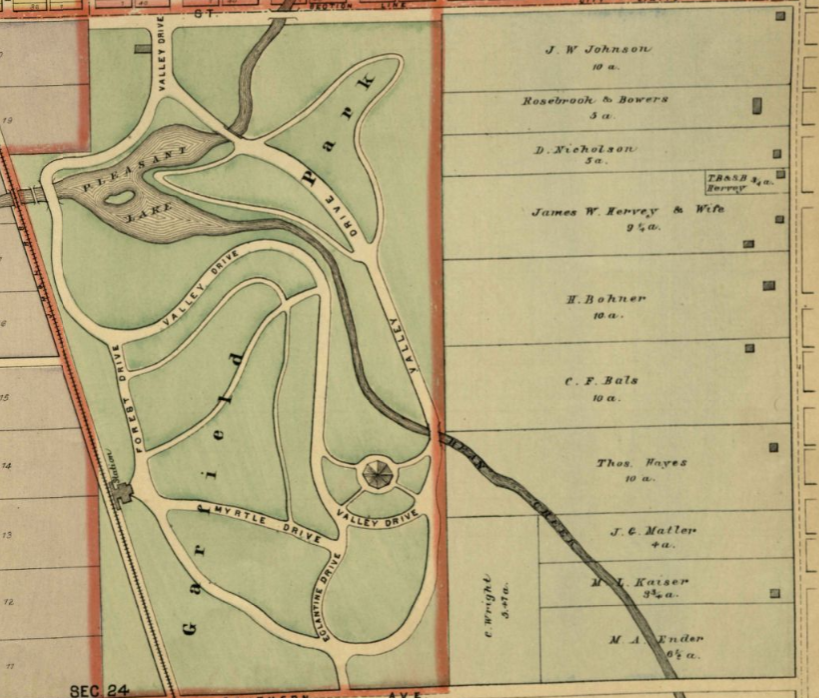
By 1901, the city had completed the eastern entrance, and the Shelby Street electric streetcar line was extended as expected. With this, two lines now connected Garfield Park to the city center.

A neighborhood takes shape
In the summer of 1904, Harry Hilgemeier married Minnie Roembke. The two presumably met through their shared German heritage and their proximity as neighbors. In 1900, Minnie and her family lived on Ringold Street, about half a mile north of the Hilgemeier home on Barth Avenue. Harry was a first-generation German American, while Minnie had been born in Germany; the Roembkes had only recently arrived in the United States in 1897.
After their marriage, Harry and Minnie settled into a new home at 814 East Raymond Street, on Lot 4 of the Hilgemeier family’s subdivision. Harry's mother, Maria, built the home next door at 810 East Raymond, where she lived with her oldest son, Frank. Christian Jr. lived behind them with his family at 2137 Applegate Street (today 713 Pleasant Run Parkway South Drive). George had relocated to a property on South Meridian Street, near his sister Mary, who had married into the Stumpf family and lived in the grand Italianate Stumpf House at 3225 South Meridian. Matilda lived with her family in rural Warren Township.
Harry and Minnie welcomed their son, Harry Jr., in 1905, followed by their daughter, Esther, in 1908. The young family found themselves on the far southern edge of Indianapolis, in a landscape caught between country and city. Open fields and small farms mingled with early subdivisions and scattered suburban houses, creating a patchwork of land surrounding Garfield Park. A 1905 notice in The Indianapolis Star advertising a public auction just a short walk from the Hilgemeier home clearly illustrates this point:

Standing on their front porch, Harry and Minnie would have watched as the rural land between Raymond Street and the new eastern entrance to Garfield Park slowly transformed into multiple additions, creating a cohesive residential neighborhood. It was in this neighborhood that they would one day build their second home.

The transformation of the landscape accelerated further when land south of the Shelby Street entrance was acquired by the city in 1914, bringing Garfield Park to its present-day boundaries. This expansion included the addition of a greenhouse and a sunken garden.

Business expansion and returning to Garfield Park
While Garfield Park was expanding and the surrounding neighborhood filled in with new houses, the Hilgemeier family business was growing as well. After its early site just north of the park, the business moved briefly to the intersection of Shelby Street and the Belt Line Railroad. When Christian Hilgemeier Jr. died in 1913, his brothers—George, Frank, and Harry—carried on the company, which by then required a larger facility. In 1912, they invested $20,000 to build a new plant at the corner of Raymond and West Streets.
The new brick facility was an impressive operation. It included cold storage, a sausage factory, a gut room, dressing floors, and offices, with the capacity to process 200 hogs a day. This scale positioned the Hilgemeiers for success in what was then Indianapolis’s leading industry. By 1918, the city’s packing houses collectively processed more than 1.3 million hogs, 268,000 cattle, and 15,000 sheep; the Hilgemeiers were one of at least eight firms competing in the trade.


Harry, Minnie, Harry Jr., and Esther remained at 814 East Raymond Street through the 1910s and early 1920s. In 1923, they made several renovations and repairs before selling the house the following year and relocating to the Hilgemeier property on South Meridian Street, where George had been living, not far from their sister Mary Stumpf and her family.
By then, Harry had become superintendent of the packing plant’s delivery fleet, while his brother George had risen to company president. The success of the Hilgemeier business in the 1920s is best reflected in the elegant Italian Renaissance–style home George built in 1923 at 4266 North Pennsylvania Street—a far cry from the modest south-side cottages of his youth.

Harry and Minnie lived at their South Meridian residence for only four years before deciding to return to the Garfield Park area. By 1927, only a handful of vacant lots remained along the park’s northeastern edge. More than 100 new houses had been built since 1908, rapidly transforming the semi-rural landscape Harry and Minnie once knew into a much denser, more urban neighborhood. The houses reflected the style of the times, with modest bungalows and Craftsman homes featuring low-pitched roofs, wide porches, and simple yet sturdy details.
In 1929, the Hilgemeiers built their brick bungalow on one of the last remaining vacant lots tucked into the elbow of Garfield Park and moved back to the neighborhood. Their daughter Esther returned with them for a short time before marrying and relocating to Evansville, while their son Harry Jr. and his wife built their own home that same year at 2701 Allen Avenue, just south of the park.
At the time Harry and Minnie built their new home, Garfield Drive was managed by the city’s Board of Park Commissioners as part of their boulevard system. The Indianapolis Star featured the street twice in 1929 in its "Our Street" column, which highlighted popular streets around the city. The paper painted a quaint picture of the neighborhood Harry and Minnie now called home:
"All the advantages of a country estate—without the cost.
This might well be the slogan of residents of Garfield drive, west of Shelby street, for they have just across the street the spacious grounds, the fountains, the sunken garden of Garfield park, truly an estate that would satisfy a plutocrat.
The well-planned appearance of the drive is distinctive. Houses are of the same general type, bungalows, some with small second stories, and of brick or brick-and-frame construction. The lawns are terraced, giving residents the advantages of privacy and better view over the park. Down the grass plot that divides sidewalk from boulevard is a row of maple trees."
Residents of Garfield Drive had glowing opinions of the neighborhood:
"Mrs. Madalene Shumaker, 2137 East Garfield drive, who has lived there sixteen years, declared that the street is the 'prettiest in the city.' 'This street is so quiet and peaceful. It is away from the factory district and all of the smoke and soot. We also are four blocks from the rumbling, clanging street cars,' she said.
'A splendid place to rear children,' Mrs. John Baumann, 2129 East Garfield drive, asserted. She said she likes the street because every one is financially able to afford a pretty neat home, an automobile if they want one, and because the yards are kept in such perfect condition. The neighbors, she added, are fine."
Harry was only able to enjoy his new home on the edge of Garfield Park for three short years; he died in 1933 at the age of 53. After her father's death, Esther returned from Evansville and moved back to her parents' house with her young daughter Lela. (she had filed for divorce after three years of marriage). For the next two decades, three generations of Hilgemeier women lived together in the home until it was eventually sold in 1950.
Meanwhile, the Hilgemeier meat-packing plant continued to expand under the leadership of George Hilgemeier and his son, George Jr. From 1928 to 1930, more than $100,000 in improvements were completed at the Raymond and West Street facility, with an additional $35,000 invested in 1940. Less than a year after the United States entered World War II, the wartime economy dealt a fatal blow to the company: a price ceiling on pork sales—without a corresponding cap on the cost of live hogs—made it nearly impossible for the mid-sized operation to remain viable. The facility was soon converted and repurposed for cold food storage.
The site of the old Hilgemeier plant was captured by the W. H. Bass Photo company through aerial photographs during the early 1950s. The plant stood until the early 2000s before part of it was demolished. Today, a portion of the old plant can still be seen as you drive down Raymond or West Streets.
The history ordinary houses hold
The home on South Garfield Drive is ordinary. There's no historic marker in its front yard and no commemorative plaque affixed next to the front door. It's one of thousands of similar bungalows built throughout Indianapolis during the first half of the 20th century. The story of how it came to be could also be considered ordinary. It’s the story of a German immigrant family making their mark on Indianapolis, a story of the city’s first public park taking root and growing, and a story of a meat-packing industry that rose and eventually declined. Ordinary though they may be, these stories are worth preserving. And as long as the house on South Garfield Drive stands, they will continue to have a place to dwell.
A note on research and sources
Every blog I publish is carefully researched, and I don't make historical claims unless they are supported by documentary evidence.
These articles are written to be enjoyable and easy to read, so I don't include comprehensive footnotes or source citations like you would find in a research report prepared for a client. Those reports are fully documented with detailed citations.
If you're curious about the sources behind this blog post or specific claim, I'd be happy to point you in the right direction or answer any questions. Feel free to reach out!


