
Researching Squankum House, Part 2

This post picks up where the first left off. If you haven’t already, you may want to start with Part 1 before reading on.
Last time, we ended with William Irwin, who built the house in 1880 with his wife, Sarah Sandusky. William sold the property in 1899. By then, Sarah and their daughter, Susan, were estranged from him and living in Danville.
The McDaniel family
William and his third wife, Mary Denny, sold the house and forty acres of farmland to Sarah’s cousin, Christopher Columbus McDaniel—known as Columbus, or sometimes “Lum”—and his wife, Mary Ida Garner.
Columbus, born in 1861, was the son of Isaac McDaniel (1818-1879) and Susan McCreary McDaniel (1822-1911); he grew up on a farm a half mile north of the Irwin family. During the 1840s and 1850s, Columbus’s father acted as trustee for the land that Sarah Sandusky Irwin had received as a childhood gift from her father.
Mary Ida Garner, also born in 1861, was one of the nine children of Harrison B. Garner (1828-1901) and Francis Lowder Garner (1831-1905). She grew up on a farm just a mile and a half south of the Irwin property. Her childhood home, built by her parents in 1865, still stands today and remains in the Garner family. The house faced north, looking across fields toward the Irwin farm, which faced south. In the nineteenth century, long before modern residential development filled the land in front of their home, Mary and her family likely watched the tall, two-story Irwin house take shape as it was being constructed in 1880.

After marrying and establishing their life in Hendricks County, Columbus and Mary moved to Lebanon in 1896, where Columbus entered the marble business, specializing in gravestones and monuments. Contemporary newspapers reported that he shipped monuments throughout the state.
One of Columbus’s gravestones still stands in Bethesda Cemetery, just east of the farm that would later become his home. It marks the grave of Josephine Knaus Sandusky (1840–1897), a cousin of John Brown Sandusky, Sarah Sandusky's father (rural Indiana in the nineteenth century was a tightly interconnected world). At the base of Josephine’s stone is a small engraving identifying its maker:

Columbus McDaniel remained in the monument business for only three years before deciding to leave the trade and return to Hendricks County. In late September 1899, Lebanon newspapers reported the sale of his entire store inventory. By then, Columbus and Mary had already secured their next home, purchasing the Irwin house and its forty-acre farm in July from William and Mary Irwin for $2,400.

Columbus and Mary were undoubtedly familiar with the Irwin family, having grown up in the same community and being related to them. As already mentioned, their connection was through William’s first wife, Sarah, who was Columbus’s cousin. Columbus and Mary were likely frequent guests at the Irwin farm prior to purchasing it.
The McDaniels lived in the house for only three years before selling it and moving to Brownsburg. The reasons for their brief tenure are unclear, though a few newspaper records suggest that Columbus preferred business to farming. In September 1902, they sold the house and its forty acres to Everson W. Eaton and Elsie McCrory Eaton. The Eaton family would become the longest stewards of the property, eventually owning the house until 2018.
The Eaton family
Everson Eaton was born in 1855, the tenth of fifteen children. His parents were Greenup Eaton (1813–1867) and Cynthia Watson Eaton (1824–1881), Greenup's third wife. He grew up in the c. 1855 Eaton home overlooking the Brownsburg–Lebanon Road (today State Road 267), just a mile east of the Irwin–McDaniel farm. One of Brown Township’s oldest houses, the Eaton home still stands today.

Elsie McCrory, born in 1867, was the eldest of four children born to George Washington McCrory (1841–1892) and Sarah Fordyce McCrory (1845–1897). She grew up on her grandparents’ farm, about two miles north of the Irwin–McDaniel farm, placing her—like Columbus McDaniel, Mary Garner, and Everson Eaton—squarely within the same close-knit rural neighborhood.
After Everson and Elsie married in 1892, they settled in Brownsburg where Everson worked as a stallion breeder.

They welcomed their first son, Frank, in 1895, and their second son, Ralph, in 1899. Their third son, Clair, was born in early 1902, and the family of five moved into the McDaniel home later that year.
The sale of the house from the McDaniels to the Eatons was likely arranged through personal connections; Columbus McDaniel and Everson Eaton were business partners in a horse-breeding venture. In 1903, an Indianapolis newspaper reported one of their more significant sales:

The earliest known photograph of the Squankum House dates to around the time the Eaton family purchased the property. Among the Eaton family’s photograph collection is an oval-shaped, hand-tinted gelatin silver print showing the house from the northwest.

The presence of this photograph within the Eaton family collection, together with its format and method of production, strongly suggests that it was commissioned as a commemorative image shortly after the family acquired the property.
The photograph is especially valuable in that it documents the house approximately twenty years after its construction, when many original features remained intact, including the operating shutters, porch, and second-story door. The image also provides important contextual information: a fruit orchard and stables are visible to the west of the house, and a detached summer kitchen appears to the rear.
This view of the house would have been familiar not only to the Eaton family, but also to the McDaniel and Irwin families.
After Everson and Elsie moved in with their three young sons, two more children joined the family: Mildred, born in 1904, and Marjorie, born in 1906. About three years after settling into the house, the family was wallpapering a downstairs room when Elsie paused to leave a penciled note directly on the wall. Remarkably, it survived more than a century of subsequent wallpaper and paint. When the plaster walls were stripped in 2019, her message was still there:

It reads:
This paper was put on May 16 1905 by Carl Clark. Ev Eaton lives here.
We have four children
Frank age 10 years
Ralph 6
Clare 3
Mildred 1
We own the place. Ev is keeping horses at Brownsburg. It has been a late wet spring not much corn planted yet
Elsie Eaton
Two years after this note was written, and just a year after the birth of his youngest daughter, Everson Eaton died on October 31, 1907—his 51st birthday. As was customary at the time, his funeral was held in the family home, and he was buried in Greenlawn Cemetery in Brownsburg. The house and forty-acre farm were left in the care of Elsie, then 40 years old, and their five children, who ranged in age from 1 to 12.
With Elsie at the helm, the Eaton family remained in Squankum and continued operating the farm. Her sister Ella and brother-in-law Clyde, along with their daughter Anna, moved in to help manage the property and assist in raising Elsie’s five children. Known as Brookside Stock Farm, the property took its name from a small stream—really a man-made drainage ditch—that ran through the farm and connected to White Lick Creek.
In the decades that followed Everson's death, Brookside became the backdrop of the Eaton children’s early childhoods. A handful of surviving photographs from the 1910s and 1920s preserve these moments.


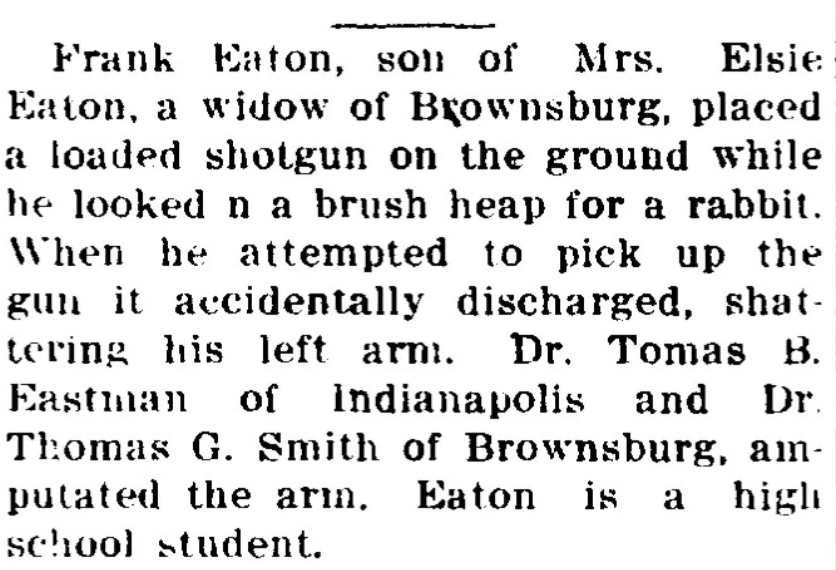
In the photographs of the Eaton boys, Frank is missing his left arm. A hunting accident was to blame, as described in a 1911 newspaper out of Lebanon:
By 1920, Ella and her family had relocated across the country to Los Angeles. Elsie’s children—now ranging in age from 14 to 25—were old enough to help run the family farm alongside her. During a later restoration of the house’s fireplace mantel, several pieces of mail from the late 1940s, from Ella’s family in California, were discovered. At some point, the letters had been placed atop the mantel and slipped into a narrow crack between it and the wall.


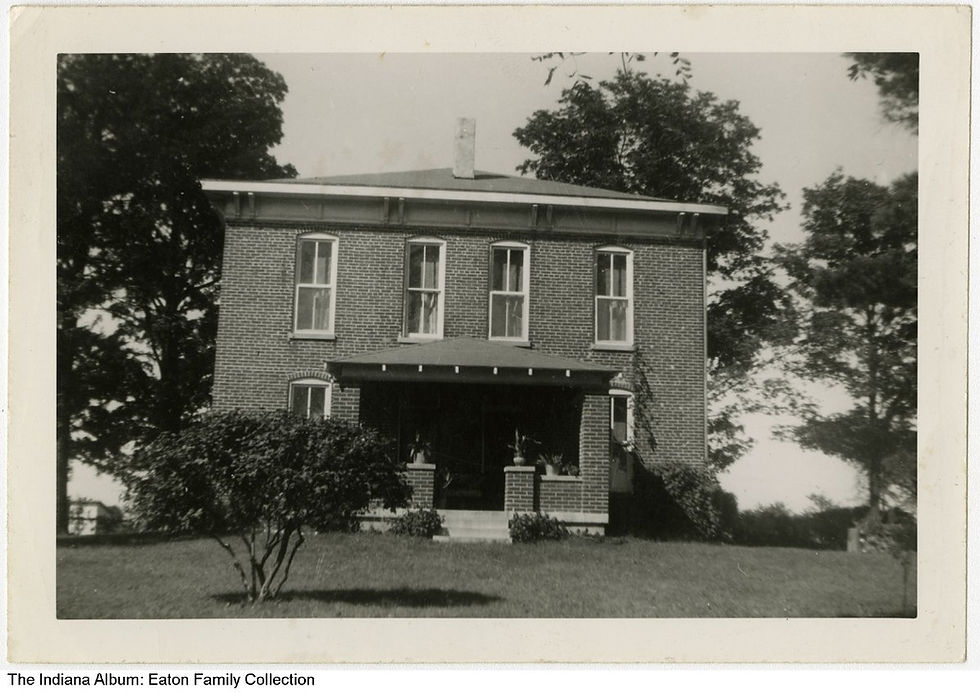
The 1930s, 40s, 50s, and 60s at the home are best represented through photographs. The Eaton Family Collection, digitized through the Indiana Album, holds many of these. A sample of some of them will finish Part 2 of Researching Squankum House. To view the entire collection, visit the Indiana Album and under keyword search enter "Eaton Family Collection" (include quotations!)




A note on research and sources
Every blog I publish is carefully researched, and I don't make historical claims unless they are supported by documentary evidence.
These articles are written to be enjoyable and easy to read, so I don't include comprehensive footnotes or source citations like you would find in a research report prepared for a client. Those reports are fully documented with detailed citations.
If you're curious about the sources behind this blog post or specific claim, I'd be happy to point you in the right direction or answer any questions. Feel free to reach out!


